Lacking any metal fasteners, every part of the Hawaiian Canoe had to be lashed into place. The making of strong cordage was essential for the construction of a canoe.

By Herb Kane
Kua'iako
Kua'iako
Lanalana
Pe'a
Kupe
Nīao
Moʻo
Prior to Western contact and the introduction of metal tools and fasteners, every component of the Hawaiian Canoe was lashed into place. The Kuaʻiako lashings (fig 1 and 4) to the Lanalana lashing (fig 2), to the Moʻo (fig3), Kupe (fig 6) and Peʻa (fig 5), were all held together with Aho .
In todayʻs canoes, lashings are largely confined to the Kuaʻiako lashings, the Lanalana lashings, and the lacing of the Peʻa. The Moʻo are today glued to the Nīao and the Kupe are made in once piece and usually glued or screwed to the Nīao of the Kaʻele.

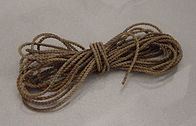


'AHO HOA WA'A
Canoe Lashing

'Aho hoa wa'a is the term used for the process of binding the 'iako to the Ka'ele (hull) and the 'iako to the ama. When lashing the 'iako to the ka'ele, several wraps were made around the wae then over the 'iako then through the puka 'iako (holes in the gunwale) then back over the 'iako and around the wae. When lashing the ama to the 'iako, several turns were taken around the ama then crossing over the top of the end of the 'iako then returning around the ama. The process of lashing called for the wraps to cross over each other at different points creating a system that prevented the lashings from coming undone should one or more of the individual lashing strands break. The lashings were also done in such a way as to absorb and dissipate the thousands of pounds per square inch of torque caused by the slamming waves in open ocean.
The rigging of a canoe was a solemn and personal event. Talking was kept to a minimum and concentration on correctly placing each wrap was kept at the highest level. The area in which the canoe was being rigged was Kapu and those not involved in the rigging process were kept away. There were many different variations to lashing patterns with each lasher having their own unique "tweaks" creating a unique form of self expression.
The lashing names presented here are in our hoʻomaʻa. Other hoʻomaʻa have different names for the same lash pattern presented here.

Kua'iako

Lanalana
Kua 'iako lashing refers to the main 'iako to Ka'ele lashing. The Kua 'iako is the part of the 'iako that spans the hull directly over the wae. There were reportedly many forms of Kua 'iako lashings but today there are two main forms of lashing that are still known. In our Halau they are called the Pa'a Li'a lashing and the Pa'a Li'a Pa'a lashing. There are variations in how the lashing was started. The first of the two used in our Halau is the "Pa'a Piko" . It begins with one end secured to the wae with a clove hitch. The entire rope was then woven over the 'iako and through the puka 'iako. The second method called the "Puka Lou" starts with a loop made in the middle of the rope then securing this loop to the middle of the Wae. Each end was then woven over the Kua 'iako and through the puka 'iako to complete the lash. Below are two examples of Kua 'iako lashings.

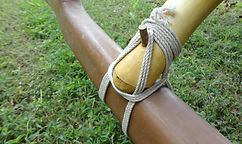
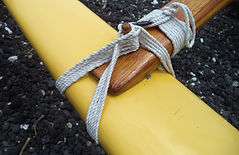
Lanalana, which means "to float" refers to the lashing of the 'iako to the ama. The end of the 'iako that was lashed to the ama was called the Kapu'ai. There were many ways to lash the ama to the 'iako some of which were very intricate and beautiful. At times multicolored lashing cord was used to enhance the beauty of the lash. Below are two examples of Lanalana lashings.
Hi'iau
Click on photo to expand view
Hi'i: To hold or carry in the arms (like a child)
Au: movement or current
Pa'a: Firm, Solid, tight, secure
Li'a: Strong desire, crave, wish for ardently
The Pa'a Li'a style of lashing is more common today. This lashing secures the 'iako to the wae in one central place. The turns around the outer sections of the 'iako are secured to the mo'o by going through the puka 'iako.
The Hi'iau lashing consists of interwoven turns of rope that cross at the end of the 'iako directly above the center of the ama then drop down and around the ama. In this example a (Pou) or peg is used to keep the aho or cordage from slipping off the end of the 'iako. A groove could be cut at the end of the 'iako to replace the pou.

Kākua
Click on photo to expand view
Kākua: To bind or fasten on, as a belt or sarong.
Doubling up on Pa'a emphisizing the "Firm, Solid, Secure,with the Strong desire.
The Pa'a Li'a Pa'a style is less common than the Pa'a Li'a style. This lashing, however, is very firm because the 'iako is lashed to the wae in three places. One in the center of the wae and two at the edge of the wae near the mo'o.
The Kākua lashing also has an interwoven cross at the end of the 'iako but also wraps around a peg or "pou" secured at the end of the 'iako specifically for this purpose.
Common Lashing Variations
Hili
Click on photo to expand view
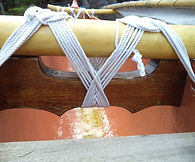
Hili : means to braid, is used to describe the lashing pattern where each turn over the 'iako and under the wae alternate.

Kaukahi
Click on photo to expand view
Kaukahi: is used to describe the form of lashing where one side of the pattern is completed before completing the other side of the lashing.
Pueo
Click on photo to ezpand view
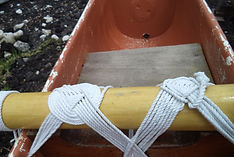
Pueo: is used to describe the method of finishing a lashing where the end of the line is slipped under the main lashings on the top of the Kua'iako in an alternating pattern.
ʻŪwi
Click on photo to expand view
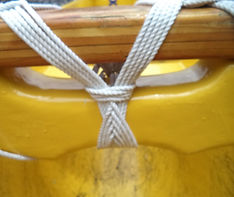
'Ūwi: means to squeeze, and is used to describe the method of finishing a lash by squeezing the center lashings with several wraps and tieing it off with a knot.
Placement of the Ama in relation to the Ka'ele

In describing the Hawaiian canoe, there is no single Hawaiian word equal to the English term “outrigger.” Instead, Hawaiians refered to the individual parts that make up the outrigger system itself. The curved booms connecting the float to the canoe hull are called the ʻiako. The float is called the ama.
Traditional Hawaiian single hull canoes used only one ama. This ama was most often attached to the left side (port side) of the canoe hull. At times the ama was mounted on the right side (starboard side), but this was uncommon and usually done to suit particular wind, current, or sea conditions that made a right-side mounting more favorable.
The outrigger system should not be thought of as simply an attachment added to keep the canoe from tipping over. It is better understood as a balancing system that works continuously with the movement of the canoe and the ocean.
The ama works through distance and leverage. Because it is held away from the hull by the ʻiako, even a relatively small ama can strongly influence the balance of the canoe. The farther the ama is placed from the hull, the greater its influence becomes.
The ama balances the canoe through a relationship between both weight and buoyancy. These two conditions work together constantly depending on how the canoe is moving and where the force is coming from.
When the canoe begins leaning toward the ama side, the buoyancy of the ama resists being pushed underwater and helps support the canoe. In this condition, the ama acts as a floating support. Woods such as hau and wiliwili naturally rise against the downward force placed upon them.
When the canoe rolls in the opposite direction and the ama side begins lifting upward, the weight of the ama itself helps hold it down against the water surface. In this condition, the ama acts more like a counterbalance, resisting excessive lift.
This shifting relationship between weight and buoyancy is what gives the outrigger system its effectiveness. The ama is never doing only one thing. It is constantly adjusting to the changing movement of the canoe, the sea, the wind, and the people inside the canoe.
The distance between the hull and ama is extremely important. Moving the ama farther away generally increases the canoe’s stability because the ama gains greater influence over the balance of the canoe. However, this can also create problems if taken too far.
An ama placed excessively far from the hull places much greater strain upon the ʻiako, especially in rough water. The hull and ama are rarely rising and falling together evenly. One may lift while the other drops as waves pass beneath them. This creates continuous pulling, twisting, and pounding forces throughout the outrigger system.
A canoe with the ama set too far outward may also become harder to steer and less responsive in rough seas. The ama may strike the water too heavily, causing the canoe to feel stiff or jerky instead of smooth and balanced.
For this reason, the placement of the ama is always a matter of balance. The canoe must be stable enough to resist overturning, but still responsive enough to move naturally with the ocean. Hawaiian canoes were not designed to overpower the sea through rigidity. They were designed to move with it.
On most traditional single hull canoes between approximately 20 and 40 feet in length, the ama was generally positioned between five and seven feet from the hull. This distance provided good balance while limiting excessive strain on the ʻiako and maintaining responsive handling.
The weight of the ama itself is also important. Traditional ama generally weighed between 30 and 60 pounds. Hau ama tended to be heavier than wiliwili ama. In our experience, an ama weighing around 50 pounds performs best on a sailing canoe because the added weight helps keep the ama engaged with the water surface during gusts and rough sea conditions. An ama that is too light may bounce or lift too easily, reducing its effectiveness.
The ʻiako themselves must also possess sufficient strength and thickness to endure the constant movement between hull and ama. On single hull canoes between 20 and 40 feet in length, ʻiako were commonly about 3 inches in diameter. Larger canoes required correspondingly larger ʻiako.
A slight toe-in of the forward ʻiako is often used to reduce the drag created by the ama and improve steering. By slightly angling the front of the ama inward toward the hull, the ama tracks more cleanly through the water and produces less resistance as the canoe moves forward.
Equally important is the vertical relationship between the hull and ama during rigging. When properly rigged, the canoe hull should possess a slight tilt downward toward the ama side when unloaded or lightly loaded. This slight “ama-down” position is intentional and extremely important.
When rigging the ama it is prefered that the bottom of the ama is anywhere between two to three inches above the bottom of the canoe hull.
As crew, gear, or sail pressure load the canoe, the hull naturally tries to roll away from the ama. If the canoe begins perfectly level while empty, the ama may lose steady engagement with the water once the canoe is underway. The canoe can then begin to feel loose, twitchy, or unstable.
By rigging the canoe with a slight tilt toward the ama from the beginning, the ama remains more consistently engaged as the canoe becomes loaded. The forces between hull and ama remain steadier and more controlled. The canoe feels more solid in its rigging, less tippy, and more predictable in rough water.
This reflects an important feature of Hawaiian canoe design generally. The canoe is not intended to remain rigid or motionless. The hull, ʻiako, and ama are all allowed to move, flex, settle, and adjust continuously with the sea. Proper rigging does not eliminate movement. It allows movement to remain balanced and controlled.


